
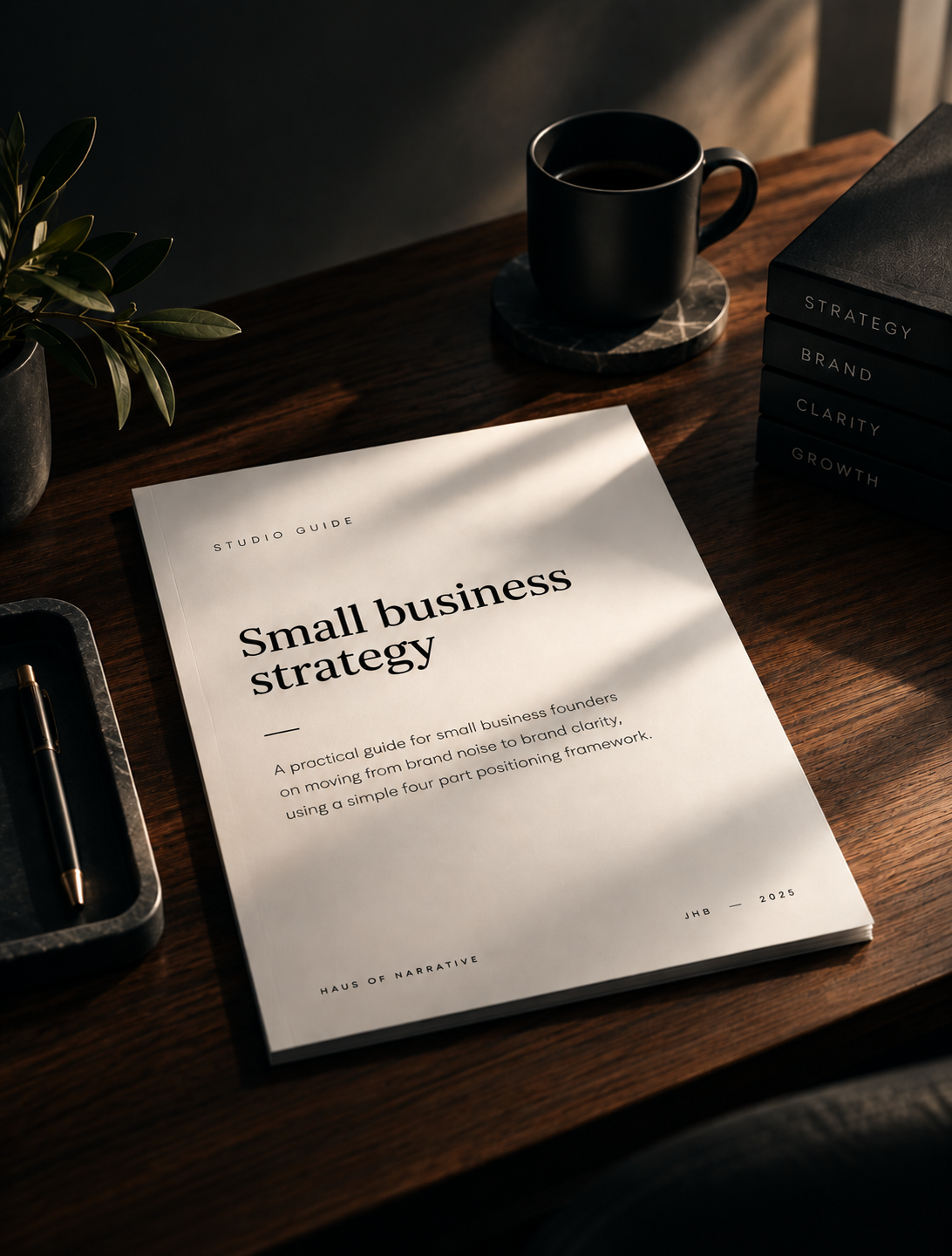
—Why Small Businesses Need Strategy, Not More Noise
Most small businesses do not have a marketing problem. They have a clarity problem dressed up as one. The posts go out. The offers change. The website gets rebuilt. And still, the business feels harder to explain than it should. Brand strategy is what quietly fixes that. It is not a logo. It is not a colour palette. It is the set of decisions that tell the business what to say, what to build, and what to ignore.
For a small business, strategy matters more, not less. A larger company can afford to be unclear for a while because it has budget to compensate. A small business does not. Every unclear message costs attention. Every inconsistent visual costs recognition. Every scattered campaign costs trust. Strategy is the way small businesses stop paying that hidden tax.
Small businesses cannot afford to be unclear. Clarity is the discount.
—What Brand Strategy Actually Is
Brand strategy is a set of clear decisions about who your business is for, what it does, where it sits in the market, and why it is worth choosing. It sits above marketing. Marketing is how you say things. Strategy is what you have decided to be. When the strategy is clear, marketing becomes easier because every decision has a reference point. When the strategy is unclear, marketing becomes exhausting because every decision starts from zero.
The good news is that a small business does not need a fifty page document to have real strategy. It needs a few decisions written down clearly enough that the whole team, or the whole founder, can use them. The four part positioning framework below is the shortest useful version of that.
—The Four Part Positioning Framework
Positioning is the heart of brand strategy. It is the answer to a simple question: in the mind of the people you want to reach, what should your business stand for? A useful positioning statement has four parts. Audience. Need. Category. Difference. Get those four right and most other decisions become easier.

—Part One. Audience
Audience is not everyone who might buy from you. It is the specific group of people your business is built to serve well. For a small business, this usually means going narrower than feels comfortable. Not because you are turning people away, but because clarity for one group tends to attract many others who recognise the same qualities.
A useful way to define audience is to describe them by situation, not just demographics. Who are they, what are they trying to do, what are they stuck on, and what have they already tried. When you can describe the audience in a sentence a stranger would understand, you have enough to move on.
—Part Two. Need
Need is the specific problem your business solves for that audience. Not a general benefit. A specific tension. A small business owner does not need better marketing in the abstract. They need to stop feeling that the business is impossible to explain. A founder does not need more content. They need to know which few things to say repeatedly so people remember them.
Write the need in the language your audience actually uses. If your customers say the words differently to how your industry says them, use their words. Strategy is not the place to sound clever. It is the place to sound recognisable.
Strategy is not the place to sound clever. It is the place to sound recognisable.
—Part Three. Category
Category is the shelf your business sits on in the customer's mind. It is how they mentally file you. If they cannot file you quickly, they will file you as forgettable. Small businesses often skip this step and pay for it later. They describe themselves in ways that are technically accurate but mentally invisible. Choosing a clear category, even a narrow one, gives the audience somewhere to place you.
You do not have to invent a new category. You can also refine an existing one. A studio, a service, a shop, a practice. Pick the word that already lives in the audience's head and then add the specificity that makes you distinct within it.
—Part Four. Difference
Difference is the reason someone chooses you over the next reasonable option. It is not a slogan. It is a real, defendable answer to the question: why this business, not another. For a small business, difference is often built on approach, taste, focus, or standard, rather than on features that a larger competitor could copy overnight.
The strongest differences are the ones your team is willing to live by even when it costs you a sale. If your difference is that you only work with clients ready to commit to a proper process, then you have to be willing to say no to the ones who are not. Positioning without discipline is just a wish.
—Writing Your Positioning Statement
Once you have the four parts, you can draft a single sentence that captures them. A simple pattern works well. For [audience], who [need], [business name] is the [category] that [difference]. It is not the finished tagline. It is the internal reference point that every other decision can be checked against.
Read it out loud. If it sounds like a slide, rewrite it. If it sounds like something a real person would say when a friend asks what your business does, you are close. Then use it as a filter. Look at your homepage, your last few posts, your recent enquiries. Do they line up with the statement, or are they slowly drifting somewhere else.
—From Strategy to Everyday Decisions
A small business feels the effect of strategy quickly because there are fewer people between the decision and the work. Once the positioning is clear, content becomes easier because the tone is already defined. The website becomes easier because the message is settled. Pricing becomes easier because the audience and difference give it context. Even the decision to say no to certain projects becomes easier because you can see how they weaken the position.
This is where the shift from noise to clarity actually happens. Not in a rebrand. Not in a new logo. In the quiet moment where the founder stops asking what to post today and starts asking what the brand should be known for over the next year.
Clarity is the quietest competitive advantage a small business can build.
—A Simple Weekly Practice
Strategy is not a document you write once and forget. For a small business, the most useful practice is short and regular. Once a week, read your positioning statement. Look at what the business actually did that week. Ask three questions. What did we do that reinforced the position. What did we do that quietly drifted from it. What one thing next week should look more like the brand we are trying to build.
This small ritual keeps strategy alive. It stops the business from slowly turning into a collection of unrelated moves. Over time, the compounding effect is more powerful than any campaign. The business becomes easier to describe, easier to refer, and easier to remember.
—When to Get Outside Help
A small business can absolutely start this work on its own. The four part framework is designed to be used by the founder, not only by a studio. Outside help becomes useful when the business has outgrown its own view of itself. When the team can no longer agree on what the brand is. When the market has shifted and the current positioning no longer fits. When the founder can feel that something is off but cannot name it clearly enough to fix it.
That is where a studio like ours comes in. Not to add more noise. To help the business decide, in a very deliberate way, what it should be known for, and then to shape the brand and the communication around that decision.
—The Point of All of This
Brand strategy for a small business is not about looking bigger than you are. It is about being clearer than you were. Clear enough that the right people recognise the business quickly. Clear enough that the wrong opportunities are easier to turn down. Clear enough that the team, or the founder, wakes up knowing what the brand stands for and what it does not.
Everything else. Marketing. Content. Websites. Campaigns. Sits on top of that clarity. Get the strategy right, even in its simplest four part form, and the rest of the work stops feeling like guesswork.